
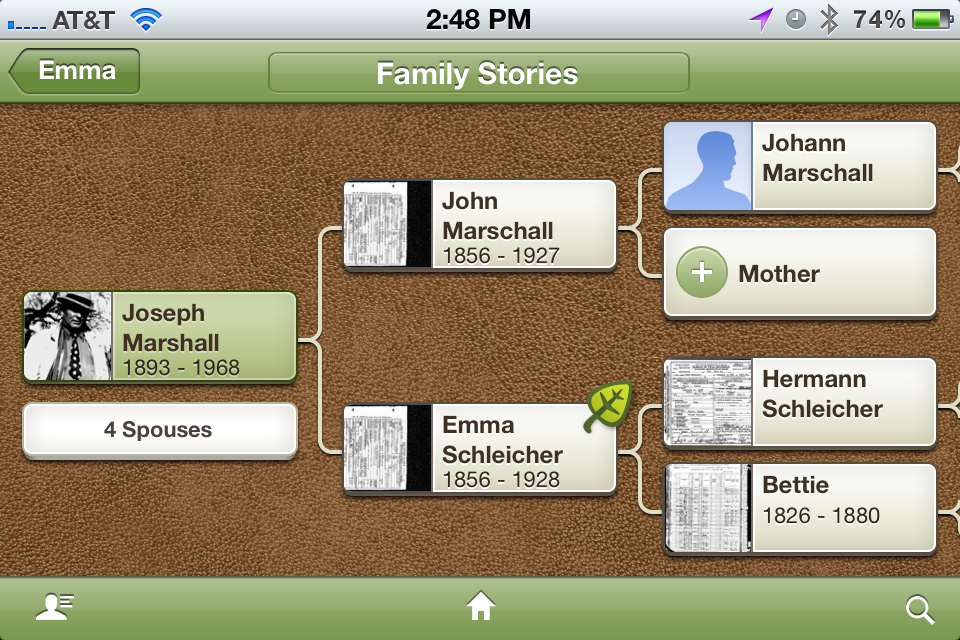
 Click for a larger image of screenshot of a pedigree chart from my iPhone. Click for a larger image of screenshot of a pedigree chart from my iPhone. A while back I asked everyone in my social networks to tell me what they thought a pedigree chart was in one sentence. To a genealogist of most levels, looks like a pretty easy question, no? Actually, it is an easy question, but as with questions of this nature [Read: pretty ambiguous question.], I received a lot of related-but-not-quite-the-same answers. [And some were just plain funny.] Makes sense if you think about it. We're all different. And? It could depend on how you plan to use the chart or how you actually have used one in the past. Take a look at just some of the answers [Help me give them a BIG thank you for particpating by clicking the links below the images for their Twitter Home Page or their Blog Home Page. Well, after you read my post. ;) ] This first group is from the 4YourFamilyStory.com Facebook Page: 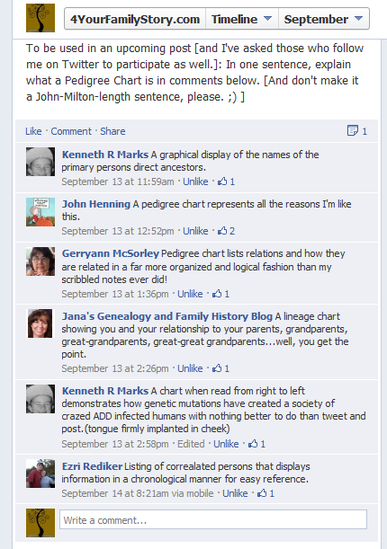 And because these folks were so brave for answering, here are the links to their blogs [If they have one & I could find it. If I'm missing one, I'm sorry, but you have my undying gratitude nonetheless.]:
This second group were some of the answers given to me on Twitter: 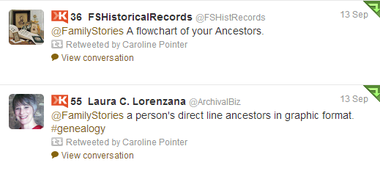  Help me thank these brave folks for answering by following them on Twitter and/or checking out their blogs: @FSHistoricalRecords @ArchivalBiz - Also check out Laura's blog, The Last Leaf on This Branch. @patmcast - Also check out Pat's blog, Peter's Blog. The following is a broad [Read: not really helpful to those of us who don't really care about phenotypes] definition from Wikipedia: "A pedigree chart is a diagram that shows the occurrence and appearance or phenotypes of a particular gene or organism and its ancestors from one generation to the next..." [1] And yet another definition ~ this time from The Source: A Guidebook to American Genealogy, edited by Loretto Dennis Szucs and Sandra Hargreaves Luebking [Read: the best definition & I'm not surprised]: "Pedigree charts provide an overview of generations or lines of descent. Pedigree charts are 'works in progress' where missing entries show areas in which further research is needed." [2] And this definition - in fact, the second sentence of this last definition - is what is critical to understanding what a pedigree chart really is or, rather, how it can be used to accomplish research tasks. 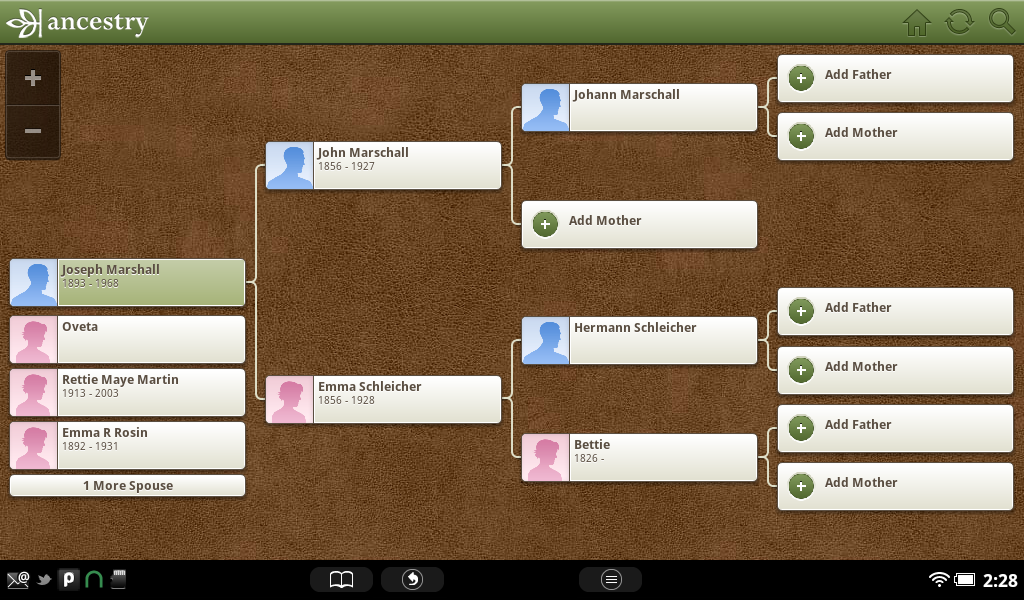 Click for a larger image of a screenshot of a pedigree chart from my Nook Tablet. Click for a larger image of a screenshot of a pedigree chart from my Nook Tablet. In my own words? A pedigree chart is a tool for your genealogy and family history research. It's where you start and where you go back to time and time again to figure out what to do next. It's an outline. It's a worksheet. [Even though some don't use the paper form, like I do sometimes. Yes, you read that correctly.] It's the foundation of your work. But what form does it take? What does it look like? In 2012, it can look like a piece of paper with a chart quickly sketched out, it can look like a white board with the chart quickly sketched out, it can look like a computer screen with your genealogy software producing the diagram from your entered data, it can look like a pedigree chart print out from your genealogy database software, it can look like a tablet with the diagram on its screen, it can look like a smartphone in your hand with a diagram on its screen, or it can look like a mind map. [Although, I don't think at times my mind's map isn't nearly as organized as that app would lead one to believe.] 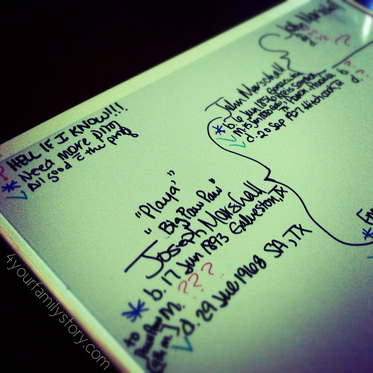 Sometimes writing it out manually helps me focus. Sometimes writing it out manually helps me focus. And there are many other creative ways it can take form in, but how and why a researcher uses it remains the same. A researcher uses a pedigree chart to figure out what they know and what they don't know so they can continue researching or share the information with others. It's what a researcher references in order to fill out their pre-research plan worksheet and their research plan worksheet. It's what a researcher uses to create their action plan for research tasks. So. What specific form it's in [or should I say, "what platform it's on"?] doesn't really matter when you're researching so long as you use it to figure out what you already know and to figure out what you need to know. And this is sometimes hard for some of us to remember to do because we often times get caught up in searching online. [And searching and searching and searching.] In the midst of all that online searching [which can be a good thing in moderation], are you remembering to check your pedigree chart? When was the last time you looked at your pedigree chart? What do you still need to find out? Happy Researching! ~Caroline Sources [1] Pedigree chart. (2012, June 16). In Wikipedia, The Free Encyclopedia. Retrieved 20:28, October 17, 2012, from http://en.wikipedia.org/w/index.php?title=Pedigree_chart&oldid=497849248 [2] Szucs, Loretto Dennis and Sandra Hargreaves Luebking, "Record Your Findings," in The Source: A Guidebook to American Genealogy, Loretto Dennis Szucs and Sandra Hargreaves Luebking, editors (Provo: Ancestry, a division of MyFamily.com, 2006), 20.  If you enjoyed this post, please share it. [Or not. You can be stingy if you want. Totally up to you.] ;)
5 Comments
10/18/2012 11:27:20 am
OK. So a pedigree chart is a person's "ground zero" basis for infinite and never-ending and evolving genealogical research plans. Or at least that's what it feels like to me right now! : - }
4YourFamilyStory
10/18/2012 12:11:20 pm
Yes! Exactly, Mariann!! Just don't forget to look at it while researching. Looking at it keeps you focused and motivated.
Laura Cosgrove Lorenzana
10/22/2012 01:25:01 pm
This is such a timely post, Caroline. I've been avoiding using Ancestry's online trees for a wide variety of reasons, but found it's portability too much to resist. And, in recreating my online tree, pretty much from 'Ground Zero' (thank you, Mariann!) I seem to have more control over the direction and depth of my research as I go back to that pedigree chart over and over. *Sigh* I'm a slow learner...but I get it now...
Caroline Pointer
10/29/2012 07:15:50 am
You're welcome, Laura. And? Isn't it refreshing to start it over and work it now that you have the experience you've gained? When I started -like a lot of folks- I got caught up in going further back rather than expanding on what I have for each person. I think that's a natural thing to do. Leave a Reply. |

|
© Copyright For Your Family Story 2016 - All Rights Reserved
|